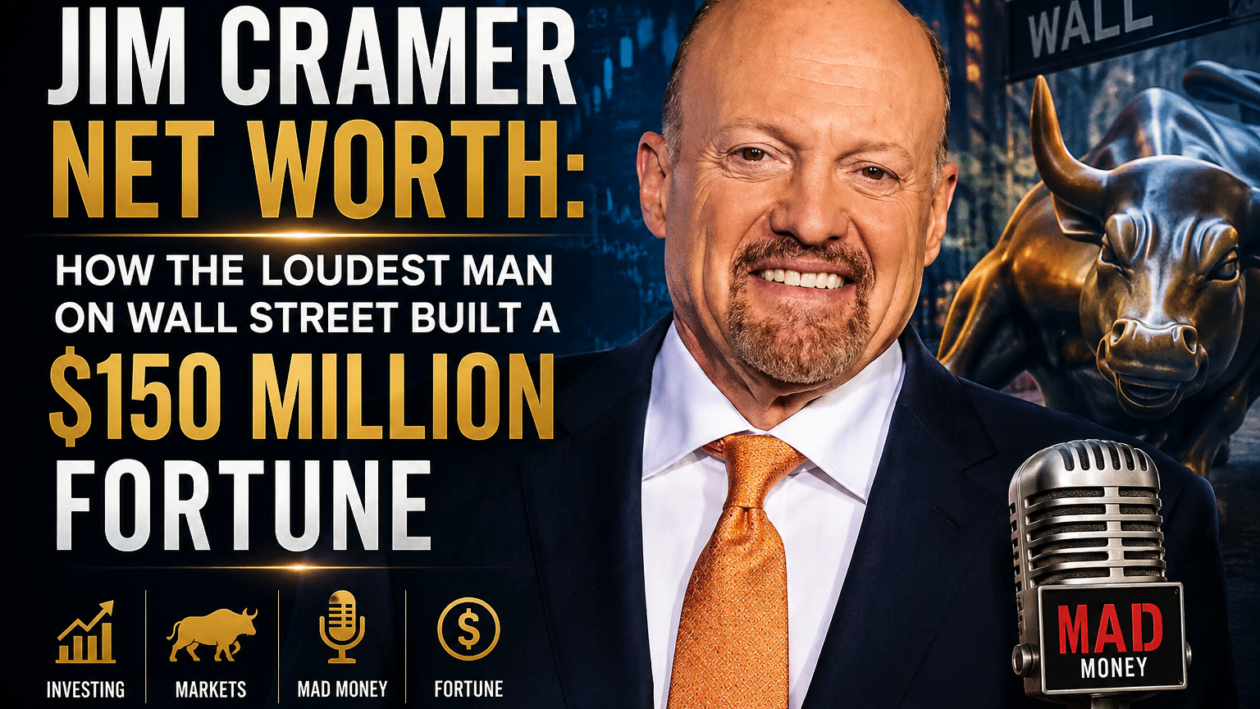
Jim Cramer net worth He yells at a camera for a living. And he’s worth $150 million doing it.
Jim Cramer net worth sits at an estimated $150 million in 2025 — and honestly, that number only makes sense when you zoom out and look at the full picture. This isn’t a cable TV guy who stumbled into money. This is a Harvard-educated lawyer turned Goldman Sachs stockbroker turned hedge fund manager turned financial media institution who happened to be extraordinarily good at one specific thing: making Wall Street feel like a sport everyone could watch.
Let’s trace exactly how that happened.
The Kid From Wyndmoor Who Sold Ice Cream at Baseball Games
He wasn’t born into money. That matters.
Jim Cramer grew up in Wyndmoor, Pennsylvania — a quiet suburb of Philadelphia — in a working family where his mother painted and his father ran a company selling wrapping paper and boxes to restaurants and retailers. Not Wall Street royalty. Not inherited wealth. Just a kid from suburban Pennsylvania with an obvious talent for selling things and an even more obvious inability to sit still.
One of his first real jobs was selling Coca-Cola and ice cream at Veterans Stadium during Philadelphia Phillies games. That’s the origin story. Not a trading floor. Not a prestigious internship. A baseball stadium in South Philly.
And then, somehow — Harvard.
THIS MOMENT DEMANDS TRUTH.
In a deeply divided country, journalism is a safeguard.
Already a member? Log in to hide these messages.
Harvard, Ted Bundy, and the Career Nobody Predicted
He studied government at Harvard College and graduated magna cum laude in 1977. While there, he ran The Harvard Crimson as President and Editor-in-Chief — which tells you the media instinct was always burning underneath everything else. It just took a few decades and a cable network to fully ignite it.
After graduation, he took an entry-level reporting job at the Tallahassee Democrat. And here’s where the story gets genuinely strange — he ended up being one of the first journalists on the Ted Bundy murder case because he lived only a few blocks from where the story was unfolding.
Not the origin story you’d expect for a future financial television star. But that’s the thing about Jim Cramer — nothing about his path was expected.
He went back to Harvard for law school. Paid his tuition by trading stocks. Not through scholarships. Not through a part-time job. Through the actual market, which he was already beating while technically studying to become a lawyer.
Goldman Sachs, a Law License He Forgot to Renew, and a Big Bet on Himself
He graduated Harvard Law in 1984 and walked straight into Goldman Sachs as a stockbroker. He passed the New York State Bar in 1985 — and then never practiced law a single day in his life. His license was eventually suspended in 2009 because he forgot to pay the registration fee.
Honestly? That detail alone tells you everything about his priorities.
In 1987, he left Goldman and bet on himself completely — launching his own hedge fund, Cramer & Co., which eventually became Cramer, Berkowitz & Co. He raised $450 million in $5 million increments and charged investors 20% of any profits he generated. Early backers included some genuinely serious names from the New York financial and media worlds.
The fund ran from 1987 to 2001. He claims a 24% average annual return over that stretch — with only one losing year across fourteen years of trading. Some of those numbers have been questioned by critics. But the fund’s overall performance was strong enough to make him genuinely wealthy long before any television producer ever called him.
What Is Jim Cramer’s Net Worth — And Where Does It Actually Come From?
So let’s get specific. Because how much is Jim Cramer worth is a question with a layered answer.
Jim Cramer net worth stands at approximately $150 million in 2025 — built across four completely different income streams over four decades. The hedge fund built the foundation. TheStreet.com — the financial news website he co-founded with Martin Peretz in 1996 — briefly made him look like a dot-com billionaire. At the peak of the bubble in 1999, TheStreet.com carried a market cap of $1.7 billion. His 15% stake alone was worth $255 million on paper.
Then the crash came. Fast and hard.
By 2005, that same stake was worth around $15 million. The site limped along for years before finally selling in 2019 for $16.5 million — a fraction of what it once appeared to be worth. So the dot-com chapter started with a paper fortune and ended with a very expensive lesson about the difference between valuation and actual wealth.
But CNBC was already happening. And CNBC changed the entire financial equation permanently.
Jim Cramer Salary — The $5 Million Annual Number Behind the Noise
Here’s what people actually want to know.
Jim Cramer’s annual salary is approximately $5 million — his total compensation across various roles at CNBC, anchored by Mad Money with Jim Cramer, which has aired every weeknight since 2005. The show was directly inspired by a one-hour radio program he previously hosted called Jim Cramer’s Real Money, which ended in December 2006 after the TV version had already taken off.
And the show has genuine guardrails attached to it — rules most viewers don’t know exist. He must disclose any stock positions connected to companies he discusses on air. He can’t trade anything he’s talked about on the show for five full days after each broadcast. Those aren’t just optics. Those are real conflict-of-interest restrictions built into his CNBC contract.
Beyond the salary, he earns meaningful income from book royalties — six published titles spanning investment strategy, market philosophy, and financial education. Combined with his other media work, his annual earnings stay substantial even two decades after the hedge fund closed.
The Dot-Com Peak, the SmartMoney Controversy, and the Origin of “Inverse Cramer”
Before the screaming and the sound effects and the theatrical buy-and-sell calls, there was a quieter and considerably more uncomfortable controversy.
At SmartMoney magazine — where he served as editor at large — he reportedly made a $2 million personal gain by purchasing stocks just before publishing articles recommending those same stocks to readers. Was it technically illegal? Legally complicated. Was it a devastating conflict of interest? Completely.
That accusation followed him into his CNBC career and fed a persistent skepticism about whether his public stock calls actually benefit retail investors or simply move prices temporarily for people who positioned earlier.
That skepticism eventually crystallized into the “inverse Cramer” theory — the idea that systematically doing the opposite of whatever he recommends is a profitable strategy. The joke became so widespread that it was eventually packaged into an actual ETF available for real money trading.
Which is either the greatest backhanded tribute in the history of financial media. Or the most brutal public verdict on a career’s worth of market calls.
Probably both. Simultaneously.
Jim Kramer Net Worth — The Quarter-Billion He Almost Had
Let’s sit with the dot-com peak number for a moment. Because the gap between what Jim Cramer actually has and what he almost had is genuinely staggering.
At the height of the bubble, his TheStreet.com stake alone was worth $255 million. That’s not counting hedge fund assets. That’s not counting anything else. If that number had held — even partially — the conversation about jim kramer net worth would be a completely different one. We’d be talking about a nine-figure fortune that started with a ten-figure peak.
It didn’t hold. The crash was swift and total. And he rebuilt from a much lower number — through television discipline, book publishing, media visibility, and the kind of relentless on-air presence that keeps a name relevant for two solid decades.
The $150 million he holds now is genuinely impressive. But it lives permanently in the shadow of the $255 million that briefly existed on paper before the market corrected everyone’s expectations.
The Personal Side — Marriages, Restaurants, and 65 Acres in New Jersey
He was married to Karen Backfisch from 1988 to 2009. They have two children together. A Summit, New Jersey home they bought together for $2.375 million in 1999 ended up transferred to Karen for $1 as part of their divorce settlement — she later sold it in 2019 for $3.675 million. That’s either a great long-term real estate play or an awkward footnote depending on how you look at it.
In April 2015, he married Lisa Cadette Detwiler — a real estate broker and general manager of The Longshoreman, a restaurant in Carroll Gardens, Brooklyn, that they co-own together.
The real estate portfolio beyond that is considerable. He paid $4.7 million in 2008 for a different Summit, New Jersey property. He owns a 65-acre estate elsewhere in New Jersey — the kind of acreage that requires a different category of maintenance conversation. He holds property in Quogue on Long Island. He co-owns the DeBary Inn in Summit with four other investors.
And he’s held Philadelphia Eagles season tickets for over twenty years. Because regardless of how much money someone makes, Philadelphia never fully lets go of you.
The Six Books Nobody Talks About But Should
The book catalog is a legitimate income stream that gets buried under the television persona.
He’s published six titles covering stock market strategy, investor psychology, and personal finance — including works on recovering from market downturns and building long-term wealth through disciplined investing. The books collectively sold well enough to generate meaningful royalty income and advance payments that added materially to his overall wealth across multiple market cycles.
The writing also established a credibility layer that the television show alone couldn’t fully provide. You can dismiss a TV personality. It’s harder to dismiss someone with six published books on a subject who ran a hedge fund for fourteen years before any camera ever pointed at him.
You Might Also Like : The Quiet Fortune Behind the Voice: Brandon Lake Net Worth, Explained
Conclusion
Jim Cramer net worth is the sum of four distinct careers — hedge fund manager, dot-com founder, author, and television personality — each running simultaneously across four decades in ways that most people would find exhausting just to read about.
He built real wealth from the hedge fund. He briefly had paper wealth from the dot-com era that would’ve made him genuinely extraordinary rich. He lost most of that in the crash. And then he rebuilt through the kind of relentless media presence that generates $5 million a year in salary, book royalties, restaurant ownership, and a real estate portfolio spread across New Jersey and New York.
Is every stock call he makes right? No. Is the inverse Cramer ETF a funny idea? Yes. Does any of that change the fact that he’s sitting on $150 million built from scratch by a kid who used to sell ice cream at Phillies games?
It does not.
Frequently Asked Questions About Jim Cramer
Q: What is Jim Cramer’s net worth in 2025?
Jim Cramer’s net worth is estimated at $150 million in 2025. His wealth came from running the Cramer Berkowitz hedge fund from 1987 to 2001, co-founding TheStreet.com in 1996, earning an annual $5 million salary at CNBC, publishing six books on investing, and accumulating significant real estate across New Jersey and New York.
Q: What is Jim Cramer’s annual salary at CNBC?
Jim Cramer earns approximately $5 million per year from his roles at CNBC — primarily as the host of Mad Money, which has aired since 2005. He’s required by contract to disclose stock positions in companies he discusses and can’t trade any stock he’s mentioned on air for five days after each broadcast.
Q: How much was Jim Cramer worth at the dot-com peak?
At the height of the dot-com bubble in 1999, his 15% stake in TheStreet.com was worth approximately $255 million based on the company’s $1.7 billion market cap. After the crash, that stake collapsed to around $15 million by 2005 — one of the most dramatic paper wealth evaporations of his career.
Q: What is the “inverse Cramer” strategy?
The inverse Cramer concept — systematically betting against his stock recommendations — became popular enough in financial circles that it was turned into a real, tradeable ETF. Whether it consistently outperforms his actual picks is debated. But the fact that it exists as a financial product is either the funniest thing in modern investing or the most pointed critique of a television career, depending entirely on your tolerance for irony.