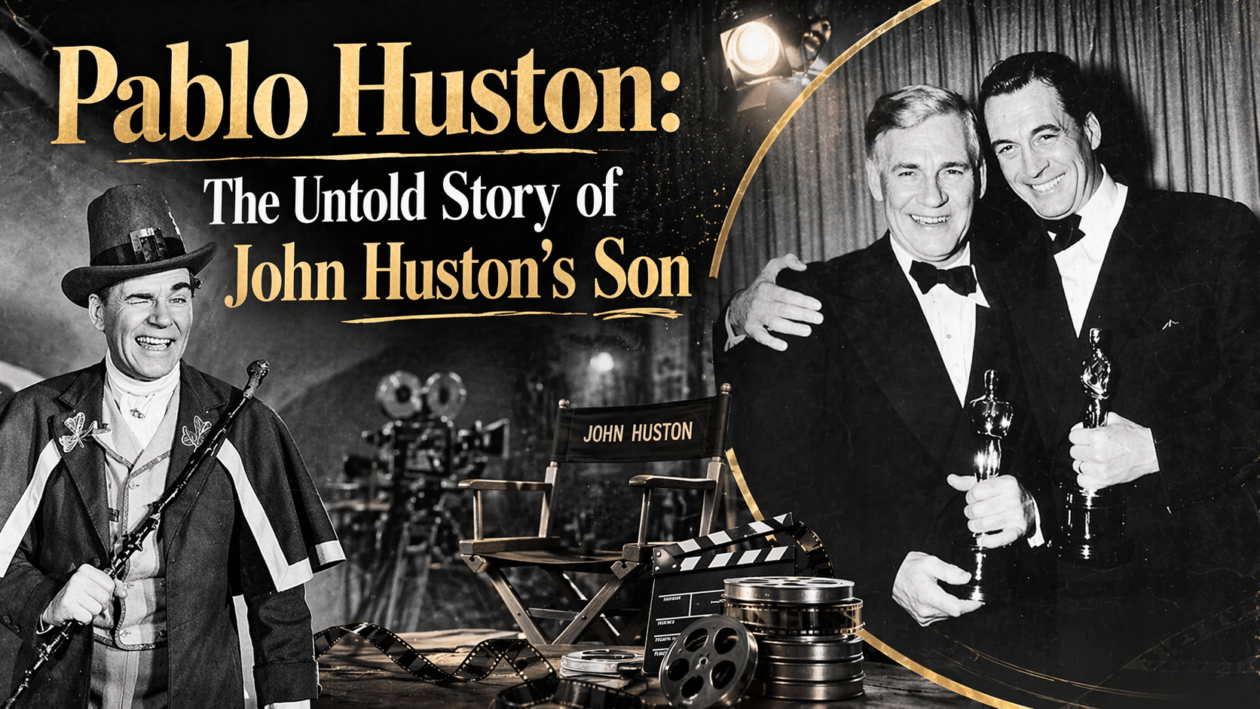
In a family defined by fame, Pablo Huston chose obscurity.
That alone makes him unusual. The son of the filmmaker John Huston, the adopted child of actress Evelyn Keyes, and the sibling of performers and writers who became fixtures of public life, Pablo inherited one of the most recognizable surnames in American cinema. He also inherited something else: proximity to a world built on visibility, mythology and reinvention.
And yet he disappeared from it.
Not in the symbolic sense that minor celebrities often do, retreating into semi-public lives of occasional interviews and nostalgic retrospectives. Pablo Huston vanished in the most literal way possible. He did not build a career in film. He did not cultivate a public identity. He left behind no verified interviews, no memoir, no reliable public account of what became of him. His name survives mostly as a footnote to a dynasty and as the subject of persistent online curiosity.
That absence has only made him more compelling.
A Child Found in Mexico
The story begins in 1948, when John Huston was in Mexico making The Treasure of the Sierra Madre, the film that would become one of the landmarks of American cinema. By then, Huston was already known as a director of force and appetite, a man whose instincts were often as sudden as they were theatrical.
THIS MOMENT DEMANDS TRUTH.
In a deeply divided country, journalism is a safeguard.
Already a member? Log in to hide these messages.
During that trip, he encountered a young orphan boy in difficult circumstances. Accounts differ in their details, but the essential outline remains the same: Huston decided, with characteristic impulsiveness, to bring the child back with him. He later wrote in his autobiography, “I had no choice but to bring him back and adopt him.”
The boy became Pablo Huston.
He was introduced, by some accounts with little warning, to Evelyn Keyes, Huston’s wife at the time and a well-known actress in her own right. It was a startling beginning to what might have seemed, from the outside, like a fairy tale: a child rescued from hardship and placed inside one of Hollywood’s most glamorous families.
But the movies have always been better at beginnings than at endings.
Growing Up in a House Built on Instability
To enter the Huston household was not to enter an ordinary family life. John Huston was gifted, charismatic and erratic, a figure whose brilliance as an artist often coexisted with disorder in his private life. He married five times. He moved restlessly through places, projects and relationships. Stability was not his defining quality.
Evelyn Keyes, remembered by many for playing Suellen O’Hara in Gone With the Wind, brought her own fame and complexity into the marriage. But that marriage ended in 1950, only a few years after Pablo’s adoption.
So the child at the center of this story experienced, in quick succession, poverty, displacement, adoption into a foreign and highly visible family, and then the collapse of the household that had taken him in. Whatever romantic aura surrounds Hollywood’s great names, Pablo’s early life suggests something harsher: not enchantment, but upheaval.
Later accounts, particularly in Keyes’s memoir, describe growing tensions and an eventual rupture between Pablo and the family. She wrote of serious difficulties and of a relationship that deteriorated. But hers is the only substantial public account, and it remains just that: one person’s version of events.
Pablo has never offered his own.
The Hustons Who Stayed in the Light
The contrast between Pablo and the rest of the family is striking.
Anjelica Huston became one of the defining actresses of her generation and won an Academy Award. Danny Huston built a steady career in film and television. Tony Huston worked as a screenwriter. Allegra Huston became a writer and editor. The family did what famous families often do: it continued to produce public figures.
Pablo did not.
He left no acting credits, no directing work, no public artistic career of any kind. In a household where ambition and performance seemed almost hereditary, he chose another path entirely. That decision can be read in many ways: as refusal, self-preservation, indifference, or simply a claim to a life that was not going to be defined by someone else’s legend.
What it clearly was not was accidental.
Privacy, especially for someone attached to a family as famous as the Hustons, does not happen on its own. It requires consistency. It requires the discipline to resist the seductions of visibility. For someone with a surname that could have opened doors across the entertainment industry, anonymity may have been the more difficult choice.
The Trouble With the Internet Biography
In recent years, Pablo Huston’s name has surfaced repeatedly online, often in articles that promise to reveal the “untold story” of the forgotten Huston son. Many of those pieces adopt the tone of certainty. They list ages, occupations, personal details and even estimates of wealth. Yet the sourcing is often weak or nonexistent.
This is how modern mythmaking works: a few verified facts are repeated, embellished and copied until speculation begins to resemble biography.
The confirmed record is small. Pablo was adopted by John Huston and Evelyn Keyes around the time Huston was filming in Mexico. He spent part of his childhood within the Huston family. At some point, the relationship broke down. After that, the public trail goes cold.
Beyond those facts lies a haze of repetition and assumption.
There is no verified public account of his adult life. No confirmed career. No reliable statement about where he lived, what he did, or whether he ever sought contact with the family whose name he carried. There is, in other words, far less known than many internet profiles suggest.
The most responsible version of Pablo Huston’s story is also the least satisfying to those who prefer tidy narratives: much of it remains unknown.
A Quiet Counterpoint to a Famous Legacy
John Huston’s artistic legacy is secure. The Maltese Falcon. The African Queen. The Treasure of the Sierra Madre. Few directors left such a commanding mark on American film. But greatness in art has never guaranteed coherence in family life, and Pablo’s story lives in the space between public achievement and private consequence.
He is part of the Huston legacy, but in a way that resists celebration. He does not fit easily into the family mythology of talent passed from one generation to the next. Instead, his life suggests a quieter and more uncomfortable truth: that proximity to brilliance can also mean proximity to instability, and that belonging to a famous family does not always feel like fortune.
Because Pablo never told his own story, his life has largely been narrated by others, or worse, by strangers filling in the blanks. Yet there is a kind of final authority in refusing to participate. To remain silent in a culture that prizes disclosure is, in itself, a decision.
Perhaps that is the most revealing fact about him.
While the Huston name continued to circulate through awards seasons, interviews, biographies and retrospectives, Pablo Huston seems to have chosen a life beyond the machinery of public attention. In a time when even minor associations with celebrity are often leveraged into visibility, that choice feels almost radical.
The Meaning of His Silence
There is a temptation, when writing about someone so absent from the record, to turn the silence into a grand statement. That should be resisted. Silence is not always symbolism. Sometimes it is simply privacy.
Still, Pablo Huston’s disappearance from public life does suggest something larger about the family into which he was adopted and about the industry that surrounded it. Hollywood has long been a place where names become brands, where personal history is converted into public narrative, and where proximity to fame can become its own form of inheritance.
Pablo declined that inheritance.
He did not publish his grievances. He did not trade on the Huston legacy. He did not step forward to correct the record or to claim his place in it. He withdrew completely, leaving behind only fragments of a beginning and none of the ending.
For a man born into one of cinema’s great dynasties, that may be the most remarkable fact of all.
Conclusion
Most people connected to Hollywood spend some part of their lives learning how to be seen. Pablo Huston appears to have spent his learning how not to be.
He was given a famous name, access to an extraordinary family and a place, however uncertain, within the mythology of American film. But whatever that inheritance offered, it did not keep him in public life. Instead, he chose distance, and he kept it.
That choice has left behind a story defined not by revelation, but by restraint. No comeback. No reckoning. No carefully managed legacy. Just a life removed from the headlines that once might have claimed it.
Some people build their names in the spotlight. Others protect themselves by stepping outside it.
Pablo Huston, it seems, did the latter.
FAQs
Who was Pablo Huston?
Pablo Huston was the adopted son of the director John Huston and actress Evelyn Keyes. He entered the Huston family in the late 1940s after John Huston encountered him in Mexico while making The Treasure of the Sierra Madre. Unlike several of his siblings, he never became a public figure.
Why is so little known about him?
Because Pablo Huston never appears to have spoken publicly about his life. There are no verified interviews, no confirmed public statements and very little reliable documentation beyond the basic facts of his adoption and childhood.
What happened between Pablo Huston and the family?
Publicly, the clearest account comes from Evelyn Keyes’s memoir, which describes a troubled relationship and eventual separation. But that account reflects only one perspective. Pablo never responded publicly, and the full story remains unknown.
Is there confirmed information about Pablo Huston’s later life?
No credible public record has established the details of his adult life with certainty. Many online articles make claims, but much of that material is not supported by verifiable sources.