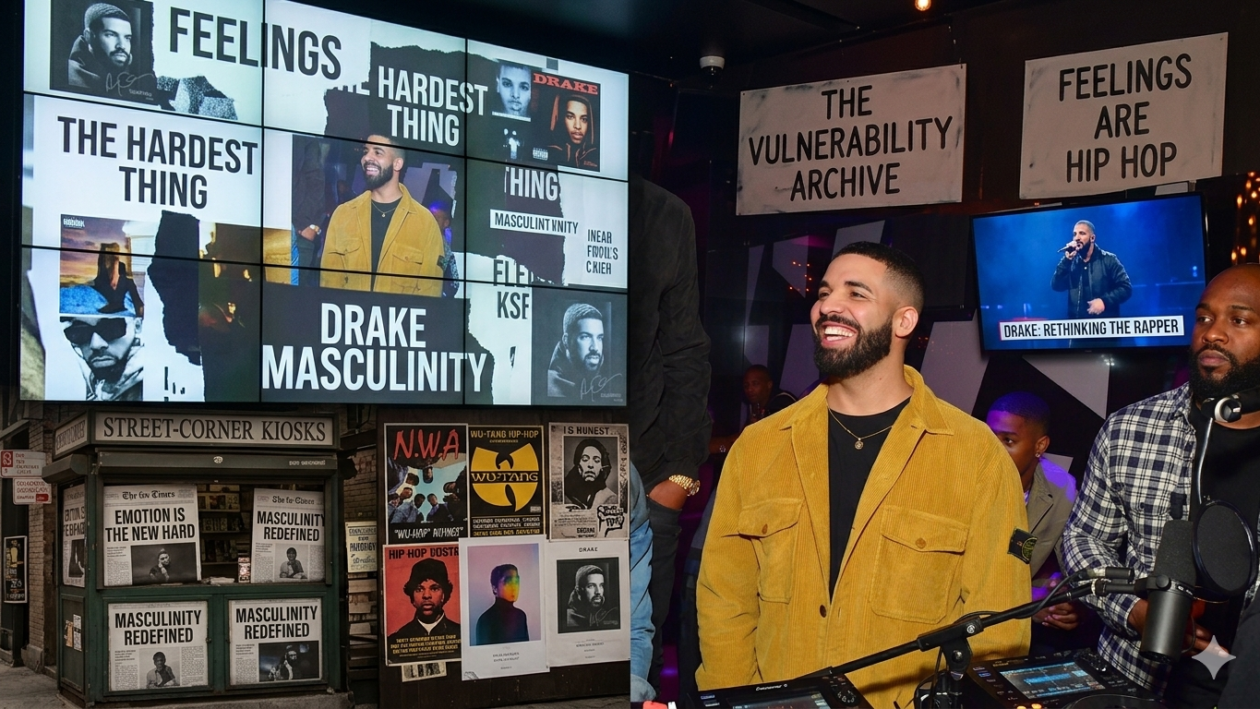
Nobody asked for this conversation. Drake started it anyway.
Drake masculinity isn’t a PR campaign or a carefully crafted brand angle — it’s what happens when a Canadian, mixed-race, former TV actor walks into the most ego-driven genre in music and just refuses to pretend he doesn’t have feelings. That’s it. That’s the whole thing. And somehow, that simple refusal changed what an entire generation of men thought they were allowed to say out loud.
Let’s be real. Hip-hop didn’t exactly roll out the welcome mat for vulnerability.
The Rules Drake Masculinity Walked In and Ignored
The genre had a code. Unwritten, but understood by everyone.
You rapped about power. About the come-up. About what you built and who tried to stop you. Emotion was allowed — but only the kind that pointed outward. Anger, triumph, grief over fallen friends. The feelings that fit neatly inside a tough exterior without cracking it.
Then Drake showed up rapping about being scared of losing someone. About hurt egos and broken hearts. About caring too much and knowing it.
THIS MOMENT DEMANDS TRUTH.
In a deeply divided country, journalism is a safeguard.
Already a member? Log in to hide these messages.
Was it jarring? Completely. Did it work? Embarrassingly well.
Drake Masculinity and the Meme That Became a Mirror
Here’s the part nobody fully planned — Drake became the internet’s emotional shorthand.
His memes spread everywhere. Not just because they were funny, though they were. They spread because they were accurate. Guys who’d never once typed the words “I’m sad” started posting Drake reaction images as a way of saying exactly that — just with plausible deniability attached.
Irony is just vulnerability in disguise. Everyone knows it. Nobody says it.
But that’s the quiet genius of what why is drake zesty did to the masculinity conversation. He gave men a side door. A way to say “this is how I actually feel” without making it a whole dramatic confession. You post the meme. You laugh. You also mean every word of it.
That’s not a small thing. That’s a cultural shift dressed up as a joke.
What Changed — And What the Old Guard Got Wrong
Hip-hop has always been emotional at its core. Anyone who tells you otherwise hasn’t listened closely enough.
But the emotions that were allowed had a very specific shape. Loss. Struggle. Victory over impossible odds. The feelings that made you look stronger for having survived them. Drake brought in a completely different emotional vocabulary — the messy, embarrassing, unglamorous kind. Romantic vulnerability. Insecurity. The specific ache of caring more than the other person does.
Honestly, that’s the emotion most people actually live inside. Nobody in hip-hop was talking about it.
So he did. And the audience — millions of them — exhaled.
The “Too Soft” Argument Was Always the Wrong Fight
Some critics came after him early. Too emotional. Too sensitive. Not a real rapper.
But that criticism was always measuring him against a standard he never agreed to meet. And that’s exactly the point about Drake’s version of masculinity — it doesn’t argue with the old rules. It just stops following them entirely. No debate. No defense. Just a pivot.
He laughed at himself constantly. He leaned into every joke at his expense. He showed up to parody his own image with genuine ease and zero defensiveness. And that kind of self-awareness — taking the hit, smiling, not flinching — is honestly more confident than any performed toughness ever looked.
Because it takes real security to be openly vulnerable in public. Anyone can build a wall. Not everyone tears one down on a track and keeps moving.
Why It Hit Different for a Whole Generation
Think about who was actually listening.
Young guys — the demographic least expected to openly discuss their inner lives — started using his music as emotional permission slips. Not in a therapy-speak, let’s-process-our-feelings kind of way. In a quiet, low-key, nobody-has-to-make-a-big-deal-about-it kind of way.
That matters. Because the biggest barrier to men engaging with their own emotions isn’t that they don’t feel things. It’s that the culture handed them no comfortable way to acknowledge it. Drake didn’t fix that completely. But he cracked the door open.
And a generation walked through it — meme first, feelings second.
He’s Not Perfect. That’s Also Kind of the Point.
Drake has a massive ego. He’d be the first to admit it and the last to pretend otherwise.
But he also laughs at himself with a frequency that most artists at his level simply don’t. He’s been the punchline of a thousand jokes, and he shows up to take the punch every single time without making it a whole situation. That combination of confidence and self-deprecation is genuinely rare — especially in a genre where image is everything.
Truthfully, that duality is what makes his take on masculinity interesting. It’s not a clean, packaged message. It’s contradictory and human and sometimes ridiculous. Which is exactly what actual masculinity looks like when you strip out the performance.
No armor. No posture. Just a guy rapping about his feelings — and selling millions of records doing it.
The Bigger Picture Nobody Wants to Give Him Credit For
Drake didn’t redefine masculinity through a speech or a statement.
He did it song by song, meme by meme, by simply refusing to be someone he wasn’t. And the culture — slowly, then suddenly — decided that was not just acceptable but actually worth listening to. Hip-hop made room for emotional complexity in a way it never quite had before, and the ripple effects are visible everywhere now. In the artists who followed him. In the conversations young men are now willing to have. In the basic cultural shift around what a man is supposed to project to the world.
Was he the only cause? No. Was he a catalyst? Absolutely.
Drake masculinity — messy, funny, occasionally cringeworthy, and completely genuine — turns out to be exactly what a lot of people needed to see.
They just didn’t know it yet.
You Might Also Like : Kalee Rogers Net Worth: The Beauty Entrepreneur Who Built a $3 Million Empire From Her Phone
Frequently Asked Questions About Drake and Masculinity
Q: How did Drake change the idea of masculinity in hip-hop?
Drake shifted the conversation by rapping openly about emotional vulnerability — heartbreak, insecurity, fear of loss — in a genre that historically rewarded toughness above everything else. He didn’t announce a movement. He just kept making music that was honest, and the culture eventually caught up with him.
Q: Why do people say Drake is “soft” — and is that criticism fair?
The “soft” criticism comes from traditional hip-hop standards that equate masculinity with emotional detachment and toughness. But honestly, that criticism misses the point entirely. It takes more confidence to be publicly vulnerable than to perform invincibility. Drake’s willingness to laugh at himself and rap about real emotions isn’t weakness — it’s a different kind of strength.
Q: Did Drake’s approach to masculinity influence other artists?
Absolutely. A wave of artists who came after him — across hip-hop and R&B — openly embraced emotional storytelling in ways that would’ve been considered career risks a decade earlier. Drake normalized the idea that male artists could be complex, sensitive, and still dominate the charts. He proved the audience was ready long before the industry believed it.
Q: Why do Drake memes connect so strongly with young men?
Because they give men a low-pressure way to acknowledge real emotions without making a formal declaration out of it. Posting a Drake meme that captures exactly how you’re feeling lets you be honest while keeping it light. It’s vulnerability through humor — and for a generation of guys raised to keep feelings private, that side door matters more than people realize.
Conclusion
Drake didn’t set out to change what masculinity means. He just refused to fake something he wasn’t — and built one of the biggest careers in music history doing exactly that.
That’s the real story. Not a revolution. Not a manifesto. Just a guy who kept showing up as himself, album after album, meme after meme, until the culture shifted around him. And it did shift. The conversations young men are willing to have now, the emotional range artists are allowed to show, the basic idea that vulnerability and strength can exist in the same person — Drake didn’t create all of that alone, but he pushed the door open harder than almost anyone.
Truthfully, the most radical thing he ever did was the simplest thing.
He felt things. He said so. Out loud. On the record.
And a generation exhaled.
Feelings first.
Always.