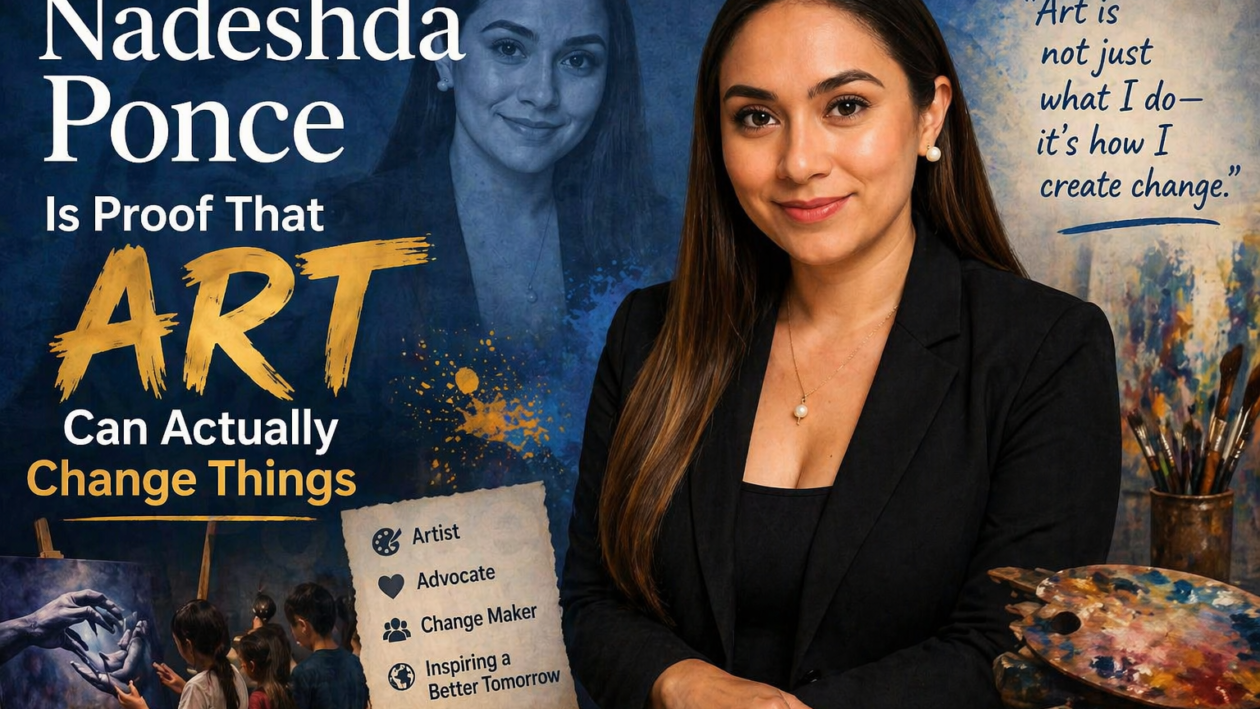
Some people change careers. Nadeshda Ponce changed everything.
She’s a contemporary artist, a humanitarian, a wellness advocate, and the kind of creative voice that makes you wonder what exactly you’ve been doing with your time. If you haven’t heard her name yet, that’s fine. But you will. Because Nadeshda Ponce is no longer a quiet story — she’s becoming one of the more interesting figures in the overlap between art, empathy, and actual social change.
And no, that’s not hype. That’s just the record.
So Who Exactly Is She?
She grew up with creativity in the walls. Not as a hobby, not as a Sunday afternoon thing — as a genuine way of understanding the world. From early on, she had this deep pull toward art, culture, and human connection that most kids spend years trying to explain away. She didn’t.
Her education touched both the fine arts and social sciences. That combination matters more than it sounds. Because it meant she didn’t just learn how to make art — she learned why art does something to people. The mentors around her kept pushing one idea: that creativity isn’t just expression. It’s a tool. For inclusion. For healing. For building something bigger than yourself.
She took that seriously.
THIS MOMENT DEMANDS TRUTH.
In a deeply divided country, journalism is a safeguard.
Already a member? Log in to hide these messages.
The Art Itself? It Hits Different.
Nadeshda Ponce works across painting, digital art, and performance. Her style blends modern expressionism with cultural symbolism — which sounds very gallery-wall-caption until you actually see the work and realize she’s communicating something you’ve felt but never quite named.
Every piece tells a story. Hope. Diversity. Transformation. The kind of evolution that doesn’t come cheap.
But here’s what actually sets her apart. She doesn’t just make art and step back. She builds it around a belief: that creativity can heal, connect, and inspire. Not metaphorically. Actually. Through workshops and exhibitions, she pushes people toward self-discovery and asks them — sometimes very directly — to find their own voice through making something.
Was this a radical idea? Maybe once. It’s becoming less radical every year. She’s part of why.
The Community Work Nobody Talks About Enough
Let’s be real — the art gets the attention. The community work doesn’t. And that’s a shame.
Because beyond the canvas, she’s been running programs for marginalized youth using art therapy and storytelling as the primary tools. Not because it’s trendy. Because it works. Kids who won’t talk will often draw. People who can’t explain their trauma will sometimes paint around the edges of it.
She gets that. And she built programming around it.
Her projects don’t stop at city limits either. Through collaborations with international organizations, she’s taken this work into conversations about mental health, women’s rights, and environmental sustainability. She uses art to advocate where straight advocacy often stalls. That’s a real skill — and honestly, a pretty rare one.
Nadeshda Ponce’s Philosophy: Art That You Feel, Not Just See
There’s a line she said in an interview that’s stuck with a lot of people: art is not just to be seen — it’s to be felt.
Simple, right? But think about how many artists actually build their whole practice around that distinction. Not many. Most are chasing beautiful. She’s chasing resonant.
Her themes orbit transformation, identity, and harmony. She works with vibrant palettes and abstract forms and symbolic imagery that doesn’t explain itself to you — it just lands somewhere and sits there, doing something. Whether it’s on canvas or digital, her work carries what she calls freedom and authenticity. You can feel both when you encounter it.
She draws from personal experience, nature, and global cultures. The result is art that bridges differences rather than underscoring them — which, given the current moment, feels almost aggressively necessary.
Recognition That Actually Means Something
Her work has shown up in galleries and exhibitions worldwide. She’s collaborated with creators and organizations across disciplines — art meeting technology meeting social innovation in ways that don’t feel forced.
She’s earned recognition for her community impact, not just her aesthetic. Critics and peers consistently point to her courage: the courage to insist that creativity and advocacy aren’t separate conversations. Because a lot of people in the art world still treat social impact as a dilution of the work. She treats it as the whole point.
And the awards have followed. Not the other way around.
Off the Canvas — What She’s Actually Like
People who work with her describe her as a visionary who stays grounded. That’s a phrase that gets thrown around a lot, so let me put it in plain terms: she doesn’t seem interested in her own mythology.
She values mindfulness. Continuous learning. Actual connection — not the performed kind. She’s humble in the way that people are humble when they’re genuinely focused on the work rather than the attention.
And she’s thinking forward. Mentorship programs. Digital platforms. A next generation of artists who combine real talent with real conscience. She wants people to understand that art doesn’t have to choose between beautiful and useful. It can be both simultaneously.
Her whole life kind of proves it.
The Social Media Piece — and Why It Works
She maintains a strong online presence that functions as an extension of the mission, not a distraction from it. What she shares online — her creative process, personal reflections, her advocacy projects — builds an inclusive digital space that actually motivates people.
That’s harder to pull off than it sounds. Most public figures’ social media eventually starts feeling like a press release. Hers doesn’t. It feels like the same person who runs the workshops and makes the art and cares about the community. Consistent. Unperformed. Real.
That’s what builds the kind of following that actually means something.
What She’s Leaving Behind
Here’s the honest version: Nadeshda Ponce is building a legacy at the intersection of things that don’t usually intersect. Art and therapy. Creativity and systemic change. Cultural depth and global reach. Individual expression and collective healing.
She’s a symbol — but not the decorative kind. The functional kind.
The aspiring artists and changemakers paying attention to her story are learning something specific: that success isn’t just recognition. It’s contribution. That the most powerful art doesn’t just sit in a gallery — it does something in the world.
And that you don’t have to pick between being an artist and being useful.
She never did.
Art that heals.
Work that matters.
One name. Remember it.