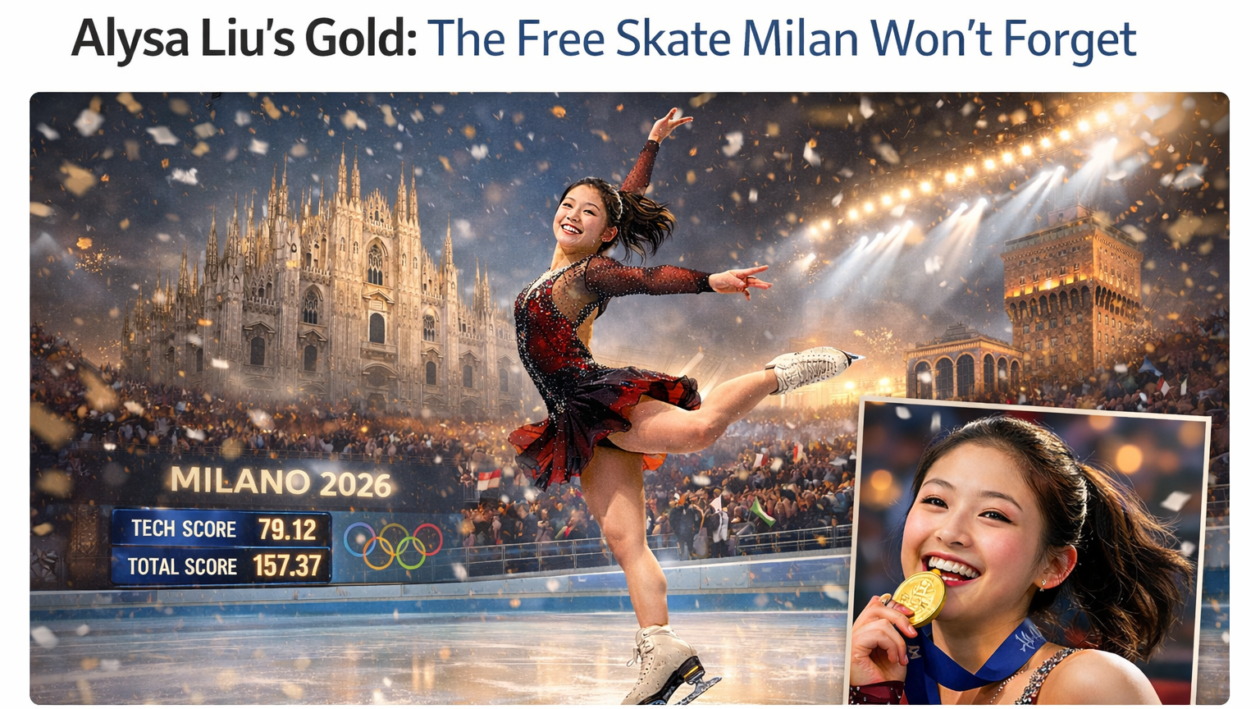
She Quit at 16. Then She Came Back and Won Olympic Gold.
That’s a long time to Wait — 24 years.
That was how long American fans had gone without seeing one of their own atop the Olympic podium in women’s figure skating. The last time? Sarah Hughes, back in 2002. And frankly, after so many near misses over the years, most people gave up on waiting for it.
Then came February 19, 2026. Milan, Italy. And Alysa Liu — a 20-year-old psychology student at U.C.L.A. who had literally walked out on the sport two years before — upended it all. But the free skating final of 2026 Winter Olympics women’s single skating became one of the most talked-about evenings in recent ice skating olympics history.
What Happened on the Ice That Night
Liu started the day in third place after the short program, with Japan’s Ami Nakai and Kaori Sakamoto ahead of her. Third do not make a particularly enviable position heading into an Olympic free skate. That’s plenty of pressure to break most skaters.
But Liu? She didn’t look cracked. She looked… calm.
Clad in glittery gold, she skated to “MacArthur Park Suite” — a program she had designed (originally) the season prior but later realigned after musical travails encountered with an intended Lady Gaga routine. It was not perfect, in a storybook way, but that’s exactly what made it seem so real. She already knew this music. She trusted it.
THIS MOMENT DEMANDS TRUTH.
In a deeply divided country, journalism is a safeguard.
Already a member? Log in to hide these messages.
Her free skate score, of 150.20 points, was also a season best — the highest in the world this season for any woman as well — and carried her from third place overall to first total with 226.79 points. That number will be the one most etched in memory among those following the 2026 winter olympics women single skating free skating coverage.
When she finished, she skated off the ice and said — frankly enough, with the mic pretty near — something NBC had to bleep. The crowd lost it. So did the internet.
The Comeback Nobody Saw Coming
Ever wondered how to give up the thing you’re not only best at but arguably born for — and return a better version of yourself?
Liu retired from the sport at age 16 in 2022, shortly after the Beijing Olympics. Her local rink in the Bay Area had closed during the pandemic, and for the first time since she began skating at age 5, she had an honest-to-goodness break. That pause became a decision. She was done.
It seemed tragic at the time. This was a girl who, at the age of 13, had become the youngest United States women’s national champion in history. She was 14 when she became the youngest skater to win two senior national crowns. Prodigy is hardly even a strong enough word.
But the thing is, she was different after the break. She returned to the sport in 2024 saying she had fallen back in love with skating, and this time she was involved every step of the way: music, choreography, costumes — all of it. The difference is this, according to her coach Phillip DiGuglielmo: She used to be dropped off at the rink and told what she had to do. Now it was collaborative.
That shift matters. Athletes who skate for themselves typically do so differently. Better.
Then Japan Had Other Ideas — And Almost Made That Come True
Let’s be honest: it was no coronation. Japan showed up to win.
Three-time world champion Kaori Sakamoto gave a lovely performance to Edith Piaf steeped in her signature class from the first pose to last bow. She has long been one of the cornerstones of women’s figure skating. And she has said this was probably her last season. That weight was not something that was kept in the dark.
But a few small errors on her jumps made the difference between gold and silver. She would finish with 224.90 — less than two points shy of Liu. By the end of the event, she was in tears. Was it the defeat or the weight of the moment ending a career? Nobody else knew.
Then there was Ami Nakai, 17. She had been first after the short program — the youngest competitor in the event — but dropped to ninth during her free skate with her “What a Wonderful World” routine, though she had enough of a cushion to still take bronze.
So Japan took silver and bronze. They owned two-thirds of the podium. Looking at the figure skating 2026 Winter Olympics medals table, Japan came out with an incredible amount of medals from this one event. But the gold went west.
The Quiet American Story No One Saw Coming
🌟 Pro Tip: One for the newcomers — The Olympic result is an amalgam of two programs, the short program (skated two days prior) and the free skate (the longer, more dramatic of the two). Total combined number determines gold. That victorious 226.79 was the sum of Liu’s 76.59 short program and her 150.20 free skate. If you’re new to ice skating olympics scoring, consider it roughly like two halves of a test — both matter, with the free skate carrying more weight.
Amber Glenn — the three-time U.S. champion, 26 — bombed her short program and plummeted to 13th place. Many had written her off. She didn’t write herself off.
She soared in the free skate for a season’s best score of 147.52, and her total of 214.91 would have placed fourth at last year’s World Championships. “I told myself enjoy it,” she said after. “I kept my feet in the Olympics. I am proud.”
She came in fifth overall. Oh, and at age 26, she was the oldest U.S. woman to take the ice in Olympic figure skating in nearly a century. And it’s not a footnote — it’s a headline.
What Makes This Free Skate Different From All the Others
And here is where it gets interesting.
Think about what this moment represented beyond the medals. Also present in the arena when Liu was awarded her gold medal were Sarah Hughes, as well as Kristi Yamaguchi, who brought home the women’s single skating gold medal in 1992. Three generations of American champions in the same building, seeing a new chapter unfold.
And then there’s the story Liu gave to the press — about how she “gets to pick her music,” how no one tells her what she can and cannot eat, how at this stage of her life she has control over the creative process. These aren’t small things. For decades elite figure skating pulled in the other direction of a culture. Liu’s presence is of a generation that wouldn’t skate anyone else’s program.
The final moments of her free skate, she said, were “bliss” — like floating. “Peak happiness,” she called it.
Honestly? Watching it, you believed her.
What Comes Next
Shortly after she won her gold medal, Liu withdrew from the 2026 World Figure Skating Championships, in what was described as a matter of an over-crowded calendar and not enough time to prepare for a particular event. Fair enough. She earned a break.
The sport also will keep changing. Judging standards are changing, fresh skaters rise and fall, age rules shift the competitive landscape. But whatever happened in Milan on Feb. 19 — at the women’s single skating free skating final at the 2026 Winter Olympics — will be referenced for years to come.
Not just because America ended a 24-year dry spell. But because a child who wanted out, who went to college, who studied psychology, who returned on her own terms and then delivered the best free skate of the season at the biggest moment in the sport.
That’s bigger than a sports story. That’s like one of those things you tell people.